
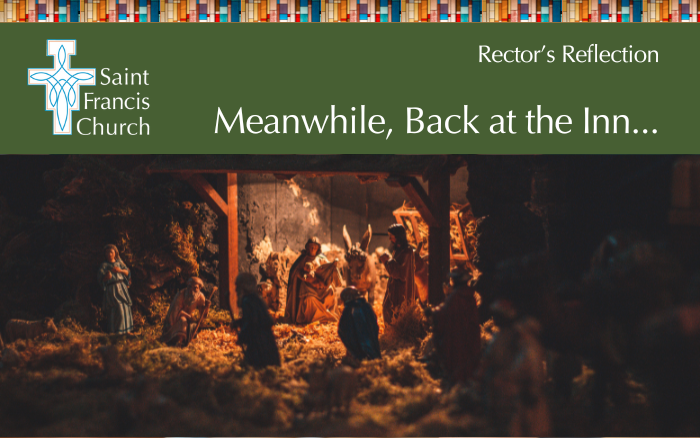
Joseph and Mary had to walk from Nazareth to Bethlehem for Emperor Augustus’s census. For years, I never questioned this statement. The Romans conducted a census every five years for tax purposes, though there was never a stipulation that men return to their ancestral homes. This would have proved to be an unreasonable hardship for many people throughout the Empire, especially legionaries, sailors, and government officials.
Why did Luke include this detail in his gospel? First, it was important that the Messiah come from the same town as David and be in David’s line, even if it was through his adoptive father Joseph. While David was the second Messiah, he was the first one that God liked.
Second, it showed Joseph and Mary (or at the very least Joseph) to be obedient Roman subjects, in contrast to Jewish Zealots who rebelled against the census and targeted people who registered.
Third, in the way it was described by Luke, the story of the census highlights the capriciousness and control of the Roman Empire. it also shows their near god-like power to intimidate people into making unwise and dangerous decisions. Mary and Joseph lived in Nazareth, which is at most 11 miles and as little as 8.6 miles away from Bethlehem. Having Mary walk for an extended period of time was a bad idea. The more prudent thing to do would have been to wait until Jesus was born, then, when it was time to travel to Jerusalem for the rights of purification (when Jesus was 40 days old), take a detour through Bethlehem and get registered.
But there’s no drama in that, nor any tension or hardship. Luke wants his readers to know how terrible and powerful the Roman Empire was (though most of Luke’s contemporaries knew well the might of Rome). He wants us to know and feel the hardship Mary and Joseph experienced. There is no birthing tent, midwife, or female relatives at hand to help Mary give birth. Jesus was laid in a feeding trough after he was born, and this was not at all common. Both the feeding trough and the barn were unclean.
It doesn’t matter if Luke’s gospel is a factual account or his interpretation of how things unfolded; what matters is the truth of the story. Truth and fact are not the same thing. It is a fact that I am married to Jennifer; it is true that I love her. I can’t empirically prove that I love Jennifer, nor can I prove that she loves me, but we both know it to be true. What’s true about the Nativity Story is that Jesus was born into a world of fear and terror, so much so that his adoptive father endangered Mary’s well-being and possibly her life in order to keep Rome happy.
What is true is that Jesus was born in squalor, not extravagance, and he was first revealed to the lowest group of respectable people (actors, athletes, and prostitutes were the only groups lower than shepherds, and they were not at all respected or considered to be respectable). Jesus’ entry into our world sets the tone for his life and for the rest of the Gospel; it’s his origin story, and Luke emphasizes what is most important to him and his audience.
What is most important to me in this story is the raw, mundane drama of it. It is everyday life turned up to 11. Yes, there were Angels, but they revealed themselves to shepherds. Yes, God was made incarnate through Jesus, but he was born in a stable. It was extraordinarily ordinary, much like our water, bread, and wine; the simple transformed into the miraculous and complex. God, the creator of all, unmatched in majesty, and God, the still, small voice in the wind, God, the crying voice of an infant, comforted by his tired and loving mom.
The Rev. Jason Shelby
Rector
jason.shelby@stfrancispalosverdes.org