
Yesterday was the Feast Day of Mary Magdalene, the apostle to the apostles. Mary Magdalene is very often portrayed as a prostitute by the church at large; this is based on one account in the Gospel of Luke where Jesus drives seven demons out of her, and she is also credited as the unnamed sinful woman who washes Jesus’ feet with the costly perfume and her tears. It could only be because of her tremendous sinfulness that she fell to his feet, right? And is there anything more tremendously sinful than for a woman to be a prostitute?
Jesus drives demons out of many people, and who among us isn’t tremendously sinful (especially when we are judged by our thoughts, not just our deeds)? But only Mary Magdalene has the misfortune of being labeled a prostitute. In the gospels, prostitutes are only mentioned as one of the people that Jesus eats with; that is, Jesus eats with sinners and prostitutes. In the gospels of Matthew, Mark, and John, Jesus first appeared to Mary Magdalene after his resurrection. He spoke to her and the other women and told them to go and tell the rest of his disciples (who were in hiding) that he had done just as he said he would and rose from the dead.
Mary was the apostle to the apostles – the first person that Jesus called by name upon his return. But by and large, people don’t think of Mary Magdalene as the first apostle; they remember her as the prostitute that Jesus saved. Because being the first apostle conferred upon Mary both honor and dignity, and because those are zero-sum commodities, if she had it, then someone else didn’t. The surest way to offset that honor was to claim that she was a prostitute.
But why offset her honor? Why go to the trouble of saying she was a prostitute? Her being a prostitute was never seen as something positive; it was meant to take away from her dignity, not add to it, which is how the WORLD thinks, not Jesus. I don’t believe that Jesus did anything accidentally or on the fly; he knew who the first person would be to see him when he came back from the dead, and he wanted that person to be Mary Magdalene. If she was a prostitute, then Jesus wanted to be found first by a prostitute. “But God chose what is foolish in the world to shame the wise; God chose what is weak in the world to shame the strong,” (1 Corinthians 1:27).
The first reading for the Feast of Mary Magdalene comes from the book of Judith, which is in our Apocrypha. It reads very much like a novel and tells the story of the widow Judith, who charms her way into the good graces of an Assyrian general who is besieging her town. Once she has his confidence, she kills him and saves her town. As she is praying in preparation for her mission, she says, “Oh Lord, your strength does not depend on numbers, nor your might on the powerful. But you are the God of the lowly, helper of the oppressed, upholder of the weak, protector of the forsaken, savior of those without hope. Please, please, God of my father, God of the heritage of Israel, Lord of heaven and earth, Creator of the waters, King of all your creation, hear my prayer!” (Judith 9:11-12)
Our God IS the God of the lowly, the helper of the oppressed, upholder of the weak, protector of the forsaken, and the savior of those without hope. Christ came not for the well but for the sick; he socialized with tax-collectors and prostitutes. If we are to call Mary Magdalene a prostitute, it should not be done in a way that shames her or takes away from her dignity, but rather in a way that points to her redemption through Christ. Further, if we adhere to the traditional notion of the church that she was a prostitute (traditional, not scriptural), we must remember that it was in her PAST.
We don’t remember Peter as the denier, nor Paul as the vengeful persecutor, but we remember them as the two pillars of the early church. Let us remember Mary Magdalene as the first apostle, the apostle to the apostles, as someone brave and faithful enough to visit the tomb before sunrise on Sunday morning, while the eleven other disciples were terrified to come out of hiding. Let us see Mary Magdalene with Christ’s eyes: a beloved child of God, the first to confess his resurrection, and a faithful servant.
The Rev. Jason Shelby
Rector
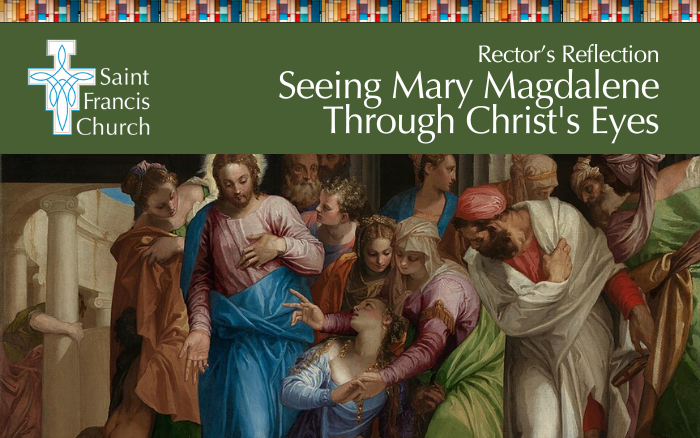
Header image: The Conversion of Mary Magdalene by Paolo Veronese (c. 1545-1548). Oil on canvas. National Gallery, London. Source: Wikimedia Commons, Public Domain.